Phlebotomy Technician (Non-Vocational) — Certificate Program

Untitled-3
Phlebotomy Technician

Certificate in Phlebotomy Technician

Learn safe and professional blood-collection techniques in a supportive, hands-on environment.
Beta College’s short, skills-focused certificate introduces you to the essentials of phlebotomy patient preparation, specimen collection, handling, and safety so you can build confidence and competence for personal interest or professional development.

  • Individuals exploring healthcare skills for personal interest or continuing education
  • Front-office or support staff in clinics/labs who want foundational knowledge
  • Internationally trained professionals seeking familiarization with Canadian practices (non-licensure)
  • Safety & Standards: Infection control, PPE, sharps handling, WHMIS awareness
  • Anatomy Essentials: Vein selection, site assessment, contraindications
  • Collection Techniques: Venipuncture, dermal puncture, order of draw, complication prevention
  • Specimen Handling: Labelling, storage, transport, quality assurance
  • Professional Practice: Patient identification, consent, communication, documentation

  • Format: Instructor-led sessions with demonstrations and supervised practice.
  • Assessment: Practical demonstrations, short knowledge checks, and scenario-based activities
  • Duration: Short – Total Qualification Time (TQT = 39 hours), focused schedule designed to fit around work and life.

  • Expert instructors with current clinical and laboratory experience
  • Small groups for individualized feedback and plenty of practice time
  • Modern labs & equipment that mirror real-world workflows
  • Certificate of Completion from Beta College (non-vocational)
  • Credential: Certificate of Completion (Non-Vocational)
  • Delivery: On-site (with selected online theory where applicable)
  • Location: Beta College of Business and Technology – Mississauga or Brampton Campus. For virtual instructor-led, live sessions (if any), via Zoom or Google Meet.
  • Admission: 18+, government-issued photo ID; basic English proficiency and computer skills recommended
  • Fees: Tuition + materials kit, if any. (inquire for current rates)
  • This non-vocational program does not provide a license or certification to practice as a regulated health professional.
  • It does not include an external clinical placement and is not OSAP-eligible.
  • Completion does not guarantee employment; it provides skills-oriented learning for personal/professional development.
Untitled-1

The Phlebotomy Technician (Non-Vocational) Certificate Program at Beta College offers a comprehensive, practical foundation in blood collection and specimen handling aligned with current Clinical and Laboratory Standards Institute (CLSI) practices.
Students gain confidence through structured learning modules designed to build theoretical understanding and technical proficiency.

Understand the human body systems as they relate to phlebotomy practice.

Key Learning Areas:

  • Commonly used veins for venipuncture
  • Differences between veins and arteries and their locations
  • Overview of the integumentary and cardiovascular systems
  • Blood composition, disorders, and diagnostic testing
  • Body planes, cavities, and anatomical terminology

Master the use of blood collection tubes and their chemical properties.

Key Learning Areas:

  • Tube identification for common laboratory tests
  • Additives and anticoagulants used in blood collection
  • Understanding SST vs. PST
  • Serum vs. plasma  differences and sample handling

Promote patient and personal safety through rigorous infection control standards.

Key Learning Areas:

  • Appropriate use of PPE
  • Safe disposal of sharps and biohazardous materials
  • Equipment safety and maintenance
  • Managing exposure incidents and reporting injuries
  • Isolation procedures and contamination prevention

Ensure optimal blood collection conditions and minimize pre-analytical errors.

Key Learning Areas:

  • Proper cleansing agents and disinfection techniques
  • Recognizing pre-analytical errors (e.g., recontamination, prolonged tourniquet use)
  • Selecting appropriate collection sites based on requisition and patient factors
  • Differentiating veins from arteries during site assessment

Apply standard practices to maintain specimen integrity and accuracy.

Key Learning Areas:

  • Inversion times and discard tube procedures
  • Consequences of incorrect order of draw
  • Selecting the correct needles, lancets, and accessories
  • Choosing proper antiseptics for specific tests
  • Checking expiry and integrity of equipment

Develop essential communication and care skills for patient-centred phlebotomy.

Key Learning Areas:

  • Reducing patient anxiety and managing needle phobia
  • Obtaining informed consent ethically
  • Verifying patient identity using proper procedures
  • Monitoring patient safety during and after collection
  • Documenting collection data accurately

Gain full procedural competency from collection to laboratory transport.

Key Learning Areas:

  • Venipuncture and capillary blood collection methods
  • Correct needle angle, site stabilization, and patient positioning
  • Handling difficult draws and preventing complications
  • Maintaining sample integrity (avoiding hemolysis, contamination)
  • Specimen labelling, centrifugation, storage, and transport
  • Packaging and delivery of specimens under proper conditions
  • Post-puncture care and safety compliance

Build essential language and literacy in laboratory communication.

Key Learning Areas:

  • Understanding key clinical abbreviations (RBC, WBC, INR, ESR, PSA, etc.)
  • Definitions of hemolysis, hematoma, and hemoconcentration
  • Proper use of terminology in documentation and requisitions

Leading academic and clinical resources support the program curriculum:
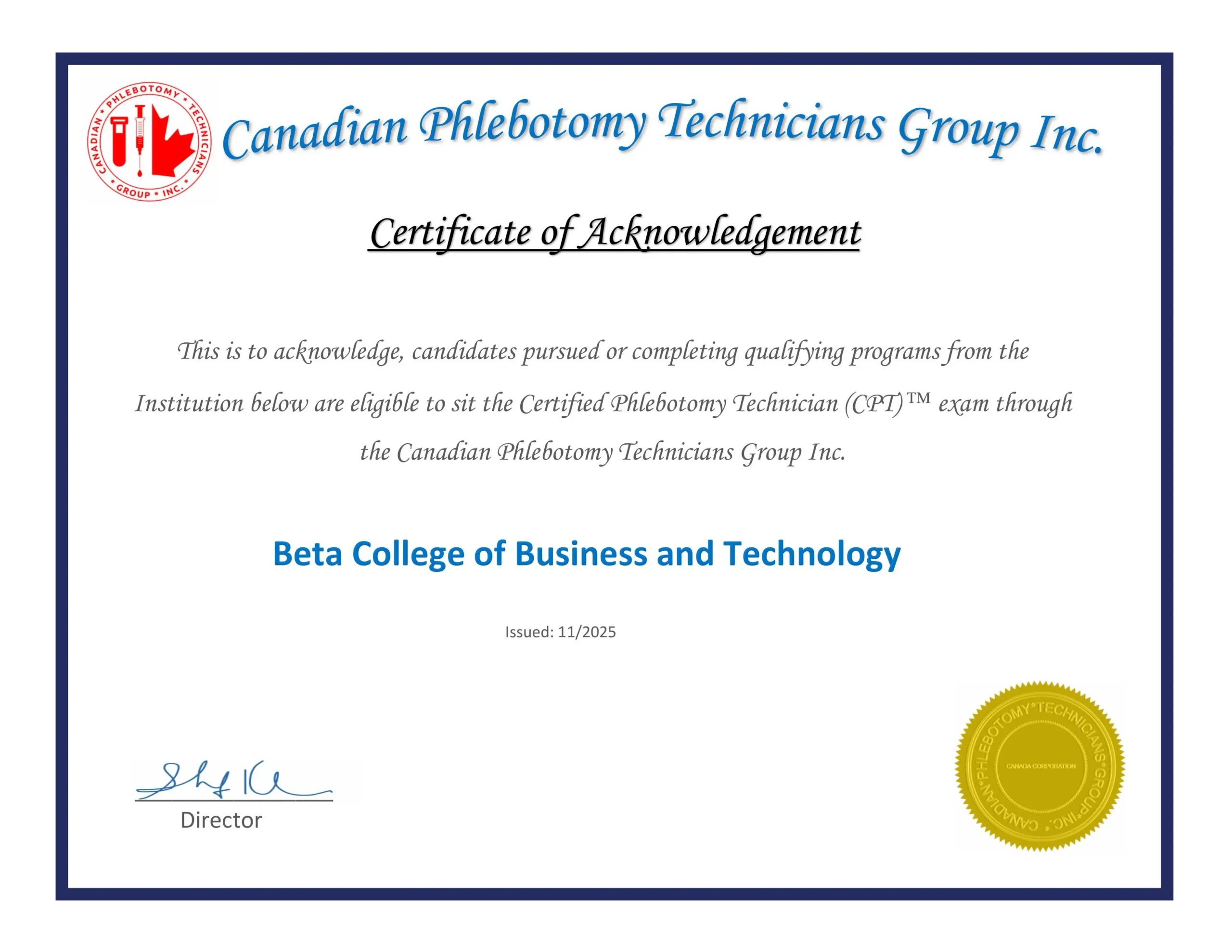
  • Phlebotomy Essentials (7th Edition) – Ruth E. McCall
  • CLSI Standard GP41: Collection of Diagnostic Venous Blood Specimens (7th Edition)
  • CLSI Tubes and Additives for Blood Specimen Collection (6th Edition)
  • Clinical Chemistry: Principles, Procedures, Correlations (8th Edition) – Bishop, Fody & Schoeff
  • New sessions open periodically. Seats are limited.
  • Contact our team for the next start date and a current fee sheet.

  • Submit the brief interest form by emailing support@mybeta.ca 
  • Receive schedule, fee details, and materials list

Email: support@mybeta.ca | Phone: (905) 848 5050 / (905) 497 9999

This is a non-vocational program offered by Beta College for personal interest and professional development. It is not a program leading to a credential under the Ontario Private Career Colleges Act, 2005. Policies regarding refunds, attendance, safety, and conduct are in effect.

Fill in the form below and we will contact you as soon as possible

    The information you provided on this form will be processed in accordance with Beta College of Business & Technology's Privacy Policy. Beta College of Business Technology will use the details you provided to get in touch with you about your inquiry.

    Fill

    Learn, Challenge and Shine

    Please fill in the below details to download the brochure.

    Get 20% Discount

    Sign up to receive updates, promotions, and sneak peaks of upcoming products. Plus 20% off your next order.


    Promotion nulla vitae elit libero a pharetra augue
    icon-abble-light.png

    Nullam quis risus eget urna mollis ornare vel eu leo. Aenean lacinia bibendum nulla sed